
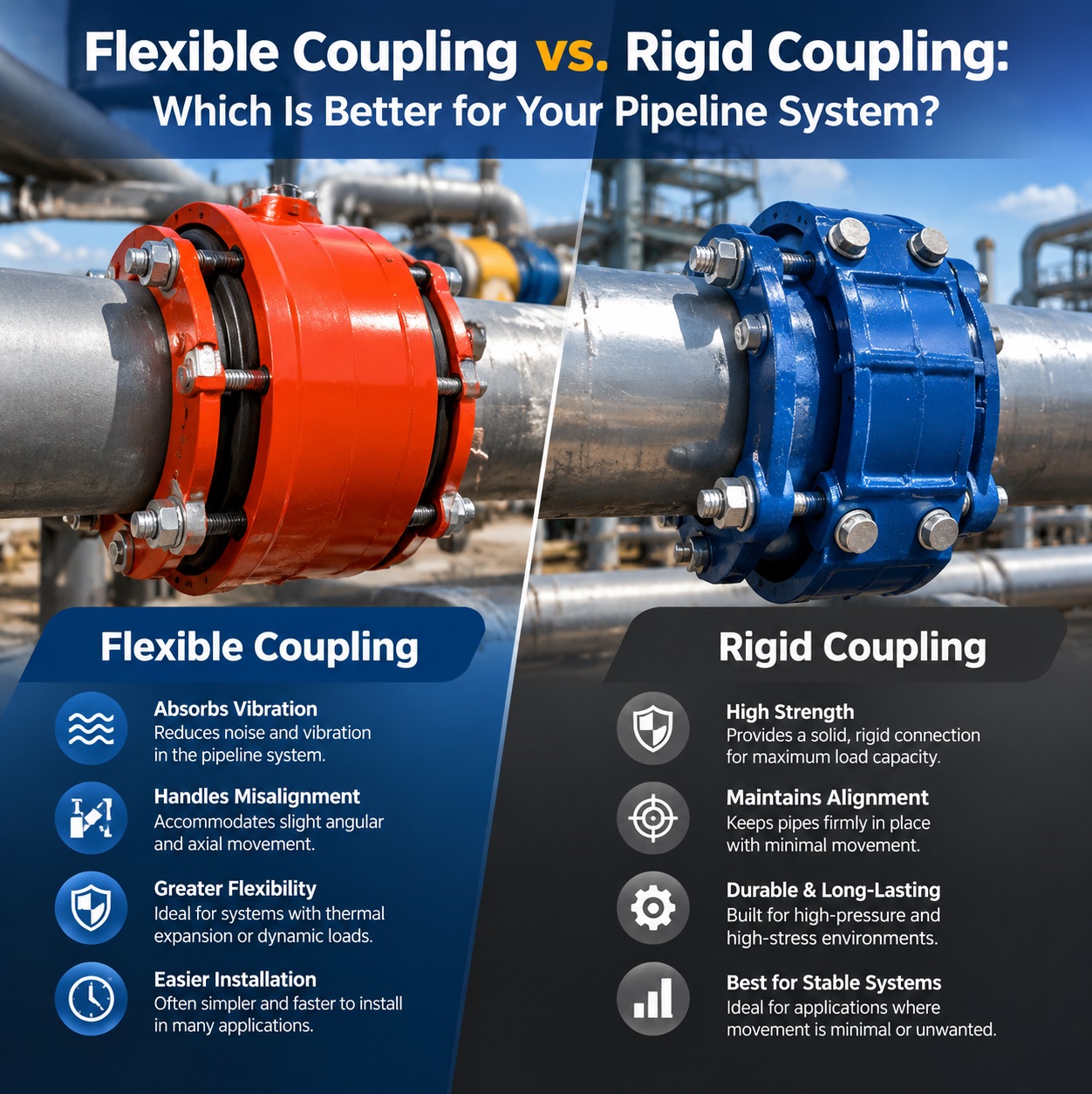
 Here’s a truth that surprises a lot of people specifying pipe for the first time: the coupling you choose can matter more than the pipe itself. Get it wrong, and you’re looking at cracked welds, leaked joints, or a maintenance crew that knows your facility by heart for all the wrong reasons. Get it right, and your pipeline quietly does its job for decades. So when the question is flexible coupling versus rigid coupling, the honest answer is that neither one wins outright. It depends entirely on what your system needs to survive.
Let’s break down what each type actually does, because the names can be misleading.
A flexible coupling does exactly what it sounds like. It allows a controlled amount of movement between pipe sections. That movement might be angular, lateral, or axial, and it happens because the coupling is designed with some give, whether through elastomeric elements, ball-and-socket geometry, or grooved connections that let the joint articulate slightly. The point is to absorb stress instead of transmitting it down the line. When ground shifts, when temperature swings cause expansion and contraction, when pumps vibrate, a flexible coupling takes that energy and dissipates it rather than letting it tear your system apart.
A rigid coupling, by contrast, locks two pipe sections into a single, unyielding unit. There’s no play, no articulation, no forgiveness. What you get instead is pure structural integrity. The joint becomes as strong as, or stronger than, the pipe wall itself. For high-pressure applications, for systems where alignment must be absolute, and for situations where you cannot tolerate any deflection, that rigidity is not a weakness. It’s the whole point.
So how do you decide? Start by asking what your pipeline is going to face.
If your system deals with significant temperature variation, flexible couplings are usually the smarter call. Thermal expansion is relentless. A steel pipe running hot process fluid can grow several inches over a long run, and if every joint is rigid, that expansion has nowhere to go. It turns into stress, and stress turns into failures. Flexible couplings give that movement a safe place to happen.
If your pipeline runs through unstable ground, seismic zones, or areas with heavy traffic vibration, flexibility wins again. Soil settles. Foundations shift. A rigid system fights these forces and eventually loses. A flexible system moves with them.
But here’s where rigid couplings earn their keep. In high-pressure process lines, in fire protection systems where code demands absolute joint integrity, and in applications where even a fraction of a degree of misalignment could cause problems, rigid is the answer. Rigid couplings also tend to be simpler to install in straight runs where alignment is already good. There’s no need to calculate movement allowances or worry about whether the joint will articulate under load. It simply holds.
The mistake people make is treating this as a binary choice. In reality, most well-designed pipeline systems use both. You might run rigid couplings through the straight, stable sections and switch to flexible couplings at critical transition points, near pumps, at building entry points, or wherever movement is expected. That hybrid approach gives you the structural strength where you need it and the resilience where it counts.
There’s also a cost dimension worth mentioning. Flexible couplings often carry a higher upfront price because of their more complex design. But that calculation flips when you factor in maintenance. A rigid joint that fails because it couldn’t handle thermal stress can mean cutting out pipe, re-welding, and shutting down operations. A flexible coupling that’s properly specified might outlast the pipe around it. Total cost of ownership rarely favors the cheaper option when the expensive option keeps failing.
One more thing to consider: installation tolerance. Real-world piping is never perfectly aligned. Field conditions introduce small deviations that drawings don’t show. Flexible couplings accommodate that reality without requiring rework. Rigid couplings demand precision, and if your installation crew is working in a tight space with limited access, that precision can be expensive to achieve.
So which is better? If your priority is absorbing movement, accommodating misalignment, and surviving dynamic conditions, go flexible. If your priority is maximum joint strength, zero deflection, and simplicity in stable straight runs, go rigid. And if you’re smart about it, you’ll use both where each one makes the most sense.
The best pipeline systems aren’t built on loyalty to one coupling type. They’re built on understanding what each joint in the system actually needs to do. Figure that out first, and the choice makes itself.