
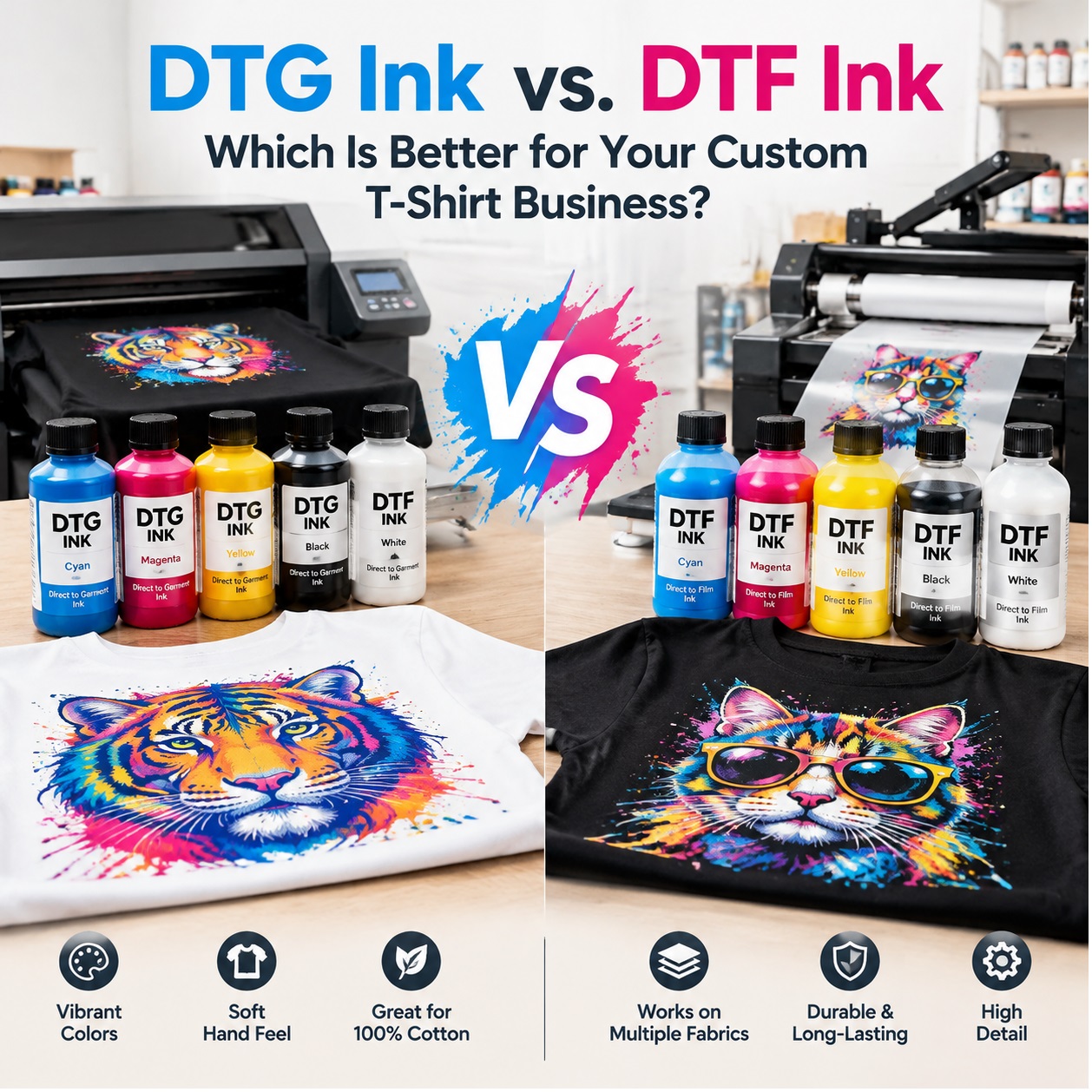
 Your ink choice is not a craft debate. It is a margin decision. If you run a custom T-shirt business, you already know the blanks, the press, the designs, and the customers. But the ink decides what you can sell, to whom, and how fast you can ship it without eating reprints.
THE QUICK ANSWER
Neither DTG ink nor DTF ink wins by default. DTG ink is a water-based ink jetted directly into cotton. DTF ink is a pigment ink printed onto film, dusted with adhesive powder, cured, then heat-pressed onto fabric. One is a premium cotton play. The other is a fabric-flexible workhorse. The right choice depends on your product mix, your labor, and the promise you make at checkout.
DTG INK: THE SOFT-TOUCH COTTON SPECIALIST
DTG ink soaks into cotton. That is why it feels like almost nothing. For retail tees, baby clothes, premium merch, and small-batch drops, that soft hand is a real selling point. Customers do not feel a plastic patch. Detailed, photographic prints on 100% cotton light shirts look excellent.
Dark shirts change the math. Pretreat is mandatory. Pretreat adds labor, can leave a faint halo, and needs proper curing. Polyester is not DTG’s friend. Dye migration can wreck bright colors. Stretch fabrics are not its best stage either. Wash durability is decent when everything is dialed in, but it is not bulletproof.
If your brand promise is soft, boutique, cotton-first, DTG ink is your friend.
DTF INK: THE FABRIC-FLEXIBLE MONEYMAKER
DTF ink sits on a transfer film, gets coated with hot-melt powder, cures, and then presses onto the shirt. That means cotton, poly, blends, canvas, denim, and some nylon are all fair game. Dark garments do not need pretreat. Color is vivid. Detail is sharp. It stretches better than many people expect when the powder and press settings are right.
It also lets you gang prints, stack jobs, and fulfill faster because you can print film ahead. The trade-off is hand feel. DTF prints have a slight film-like layer. On large solid areas, some customers call it rubbery. It can crack if stretched too hard or pressed wrong. You also need a powder shaker, oven, or dedicated curing setup. DTF ink is not cheaper by magic. It shifts cost from pretreat and labor to film, powder, and machine time.
WHERE THE MONEY ACTUALLY GOES
A DTG shop often wins on simplicity for cotton. One printer, pretreat, heat press, done. But dark shirts eat pretreat, time, and reprints. A DTF shop can handle more fabrics and fulfill faster, but film, powder, and waste add up.
Your real cost per shirt includes ink, pretreat or film, powder, labor, failed prints, packaging, and returns. If a customer returns a shirt because the print cracked after three washes, saving forty cents on ink is not a win. It is a lost order, a bad review, and a customer who will not come back.
WHICH ONE SHOULD YOU BUY?
Ask what you sell. If your catalog is 100% cotton tees, light colors, soft-hand prints, and small batches for local brands, DTG ink makes sense. If you print on poly performance shirts, 50/50 blends, dark garments, tote bags, and need fast turnaround with no pretreat, DTF ink is the practical choice.
If you can afford both, run them as a hybrid. DTG for premium cotton. DTF for everything else. That combo covers more orders and keeps you from turning down profitable jobs.
MARKETING ANGLE: SELL THE DIFFERENCE
Do not list ink types like a spec sheet. Sell the result. DTG: printed into the cotton, not on top of it, soft enough to forget you are wearing it. DTF: bold color that survives polyester, blends, and real life.
Put wash instructions on every product page. Show close-up photos. Post a wash-test video. Add a care card. Customers do not buy DTG or DTF. They buy a shirt that still looks good after the fifth wash. Your ink choice is just the backstage decision that makes that promise possible.
THE VERDICT
There is no universal winner. DTG ink is better for soft, premium, cotton-heavy work. DTF ink is better for fabric variety, dark poly, speed, and durable vivid color. The better ink is the one that matches your blanks, your designs, your labor, and the promise on your storefront. Pick that, and your custom T-shirt business stops guessing and starts printing profit.